Exercise Profile
Target Muscle Group:
Primary: Rectus Abdominis (Upper and Lower Abs)
Secondary: Hip Flexors, Obliques, Transverse Abdominis, Quadriceps (isometrically)
Exercise Type:
Bodyweight / Core Strengthening
Compound (Multi-Joint Exercise)
Equipment Required:
None (Mat optional for comfort)
Mechanics:
Compound (Multi-Joint Exercise)
Force Type:
Pull (Concentric & Eccentric Phases)
Experience Level:
Intermediate to Advanced
Best For:
Core Strength, Ab Definition, Functional Fitness, Athletic Performance, Home Workouts
Common Risks:
Lower back strain from poor form or lack of core engagement, neck tension if improperly executed
Overview
The V-Up exercise is a powerful core workout that targets both the upper and lower abs simultaneously. By lifting both your arms and legs in a synchronized motion, this move forces your entire core to engage, making it highly effective for building abdominal strength and definition. Often used by athletes, gymnasts, and military programs, V-Ups are one of the best bodyweight exercises for improving core stability, explosive strength, and total-body coordination.
Exercise Instructions
Step-by-Step Form:
Setup:
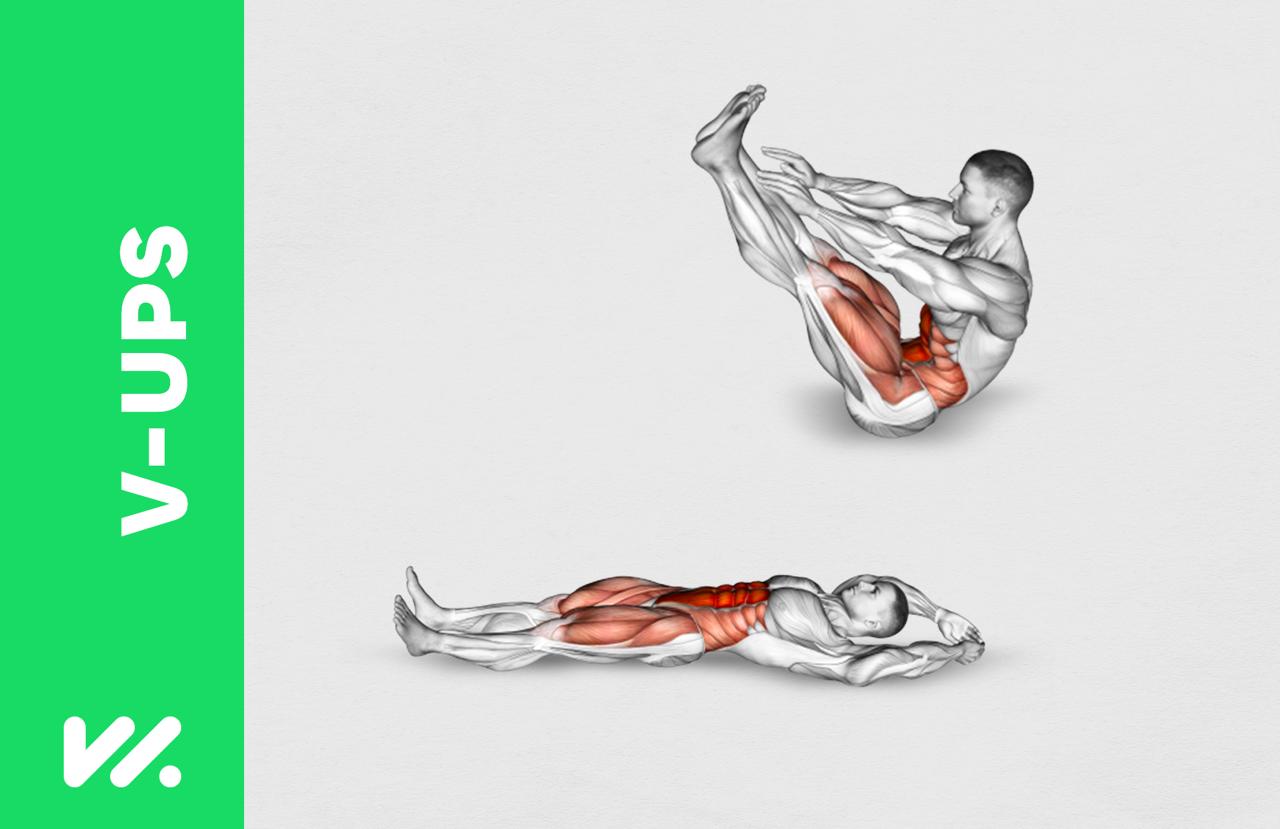
Lie flat on your back with legs extended and arms stretched overhead.
Engage your core and press your lower back into the floor.
Starting Position:
Keep your arms and legs straight, hovering slightly off the floor.
Brace your core to stabilize your spine.
Contraction Phase:
Exhale as you lift your legs and upper body simultaneously to meet at the top.
Reach your hands toward your toes, forming a “V” shape with your body.
Keep your core tight and legs as straight as possible.
Peak Contraction:
Pause at the top of the movement, squeezing your abs and maintaining balance.
Avoid rounding your spine or jerking the motion.
Returning Phase:
Inhale and slowly lower your arms and legs back to the starting position.
Resist the urge to drop—control the descent for maximum tension.
Repetitions:
Perform 2–4 sets of 10–20 reps depending on your fitness level.
Modify with bent knees or crunches if needed.
Professional Tips
Maximize Results:
- Focus on slow and controlled movements—avoid rushing.
- Engage your lower abs by pressing your back into the floor before lifting.
- Keep arms and legs straight for a full range of motion and more core engagement.
Avoid Common Mistakes:
- Don’t swing your arms or legs to generate momentum.
- Avoid arching your back—maintain a neutral spine throughout.
- Don’t hold your breath—keep a steady, controlled breathing rhythm.
Progression:
- Start with tuck-ups (bent knees) if you’re a beginner.
- Add ankle weights or hold a light medicine ball for resistance.
- Combine with planks or leg raises for a complete ab workout circuit.
Benefits of V-Ups
- Full Core Activation: Targets both upper and lower abdominal muscles in one dynamic movement.
- Improves Core Strength and Balance: Strengthens deep core muscles, improving posture and stability.
- Builds Ab Definition: Helps create that coveted six-pack abs look with consistent training.
- No Equipment Needed: Perfect for home workouts, travel routines, or minimalist training plans.
- Athletic Performance: Enhances explosive power, coordination, and functional movement used in sports.
Variations & Alternatives
- Tuck-Ups: Easier version with bent knees—great for beginners.
- V-Up Pulses: Add pulses at the top of the movement for added core burn.
- Weighted V-Ups: Hold a dumbbell or medicine ball to increase intensity.
- Hollow Hold: Isometric version to build core endurance.
- Toe Touches: Isolate upper abs with less hip flexor activation.
Incorporate the V-Ups
Use V-Ups in your ab workout routines, HIIT sessions, or bodyweight circuits to target your core from multiple angles. They pair well with plank variations, mountain climbers, and leg raises for a complete core training program. Try performing them at the start of your workout for activation or at the end as a core finisher.
“V-Ups are a top-tier movement for building a strong, athletic core. They’re a go-to choice for athletes who need explosive strength and core stability on the field or in the gym.”
— Certified Strength and Conditioning Specialist (CSCS)