Exercise Profile
Target Muscle Group:
Primary: Latissimus Dorsi (Lats), Rhomboids, Trapezius
Secondary: Posterior Deltoids, Biceps, Erector Spinae, Core Stabilizers
Exercise Type:
Strength Training / Hypertrophy
Compound (Multi-Joint Exercise)
Equipment Required:
T-Bar Row Machine or Barbell with Landmine Attachment (or corner setup)
Mechanics:
Compound (Multi-Joint Exercise)
Force Type:
Pull (Concentric & Eccentric Phases)
Experience Level:
Intermediate to Advanced
Best For:
Back thickness, mid-back strength, posterior chain development, mass building, lat width and density
Common Risks:
Lower back strain from poor form, rounding of the spine, jerking the weight
Overview
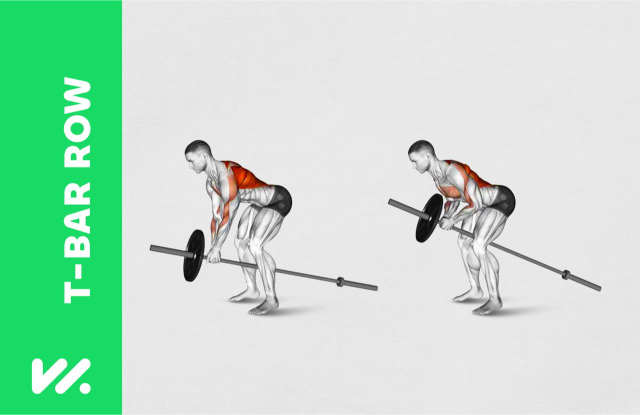
The T-Bar Row is a powerful compound back exercise that emphasizes lat thickness and overall mid-back development. With the torso hinged forward and the barbell fixed to the ground or landmine attachment, this movement allows for heavy loading and intense muscle contraction, particularly in the rhomboids, trapezius, and lats. A staple in bodybuilding and strength programs, the T-Bar row is ideal for anyone looking to build a thicker, denser back and improve posture, pulling strength, and performance in lifts like deadlifts and rows.
Exercise Instructions
Step-by-Step Form (Landmine T-Bar Row Setup):
Setup:
Anchor one end of a barbell into a landmine attachment or corner of a rack.
Load the other end with your desired weight plates.
Straddle the bar with a close-grip handle, v-handle, or wide grip attachment under the loaded end.
Starting Position:
Hinge at your hips, keeping a flat back and slight bend in the knees.
Grab the handles with both hands, arms extended, and chest lifted.
Your torso should be at about a 45-degree angle.
Contraction Phase:
Exhale and pull the weight toward your chest by bending at the elbows and retracting your shoulder blades.
Focus on squeezing your lats, rhomboids, and traps at the top.
Peak Contraction:
Pause at the top of the movement for 1–2 seconds and hold the back contraction.
Avoid jerking or using momentum.
Returning Phase:
Inhale and slowly lower the weight back to the starting position.
Maintain control and tension throughout the descent.
Repetitions:
Perform 3–5 sets of 8–12 reps depending on your strength and hypertrophy goals.
Use moderate to heavy weight while maintaining form.
Professional Tips
Maximize Results:
- Keep your torso fixed and avoid rounding your back.
- Initiate the pull with your elbows and squeeze your back muscles at the top.
- Use a full range of motion—let the arms fully extend at the bottom without collapsing posture.
Avoid Common Mistakes:
- Don’t yank the weight or bounce at the bottom.
- Avoid rounding the spine or lifting with your lower back.
- Don’t use excessively heavy weights that compromise form.
Progression:
- Add more plates gradually to overload the movement safely.
- Use pause reps or tempo reps for increased time under tension.
- Alternate grip widths to emphasize different areas of the back.
Benefits of the T-Bar Row
- Mid-Back Thickness: One of the best lifts for building density and muscle mass in the mid and upper back.
- Posterior Chain Strength: Engages the entire posterior chain, including erector spinae, glutes, and hamstrings.
- Improves Pulling Power: Boosts performance in deadlifts, rows, and pull-ups.
- Better Posture and Scapular Control: Reinforces scapular retraction and shoulder blade movement.
- Versatile and Heavy-Hitting: Allows for progressive overload and can be performed with different grip styles and attachments.
Variations & Alternatives
- Chest-Supported T-Bar Row: Reduces lower back strain by supporting the torso.
- Barbell Bent-Over Row: Free-weight alternative for complete back development.
- Seated Cable Row: Machine-based horizontal pulling option.
- Dumbbell Row: Unilateral alternative for fixing imbalances.
- Machine T-Bar Row: Provides more stability and fixed movement path.
Incorporate the T-Bar Row
Use the T-Bar row as a primary lift in your back day, pull workouts, or upper body hypertrophy sessions to build a strong, muscular back. Best placed early in your routine, it pairs well with lat pulldowns, pull-ups, and face pulls for a complete back attack. Adjust grip, tempo, or load depending on your training phase and goal.
“If you want a big, thick back, the T-Bar row should be one of your go-to lifts. It hits everything from your lats to your traps, building true pulling power and density.”
— Competitive Strength Coach (CPT, CSCS)