Exercise Profile
Target Muscle Group:
- Primary: Gastrocnemius (Upper Calf)
- Secondary: Soleus (Lower Calf), Achilles Tendon
Exercise Type:
- Strength Training / Hypertrophy
Equipment Required:
- Standing Calf Raise Machine
Mechanics:
- Isolation (Single-Joint Exercise – Ankle Plantar Flexion)
Force Type:
- Push (Concentric & Eccentric Phases)
Experience Level:
- All Levels (Beginner to Advanced)
Best For:
- Calf Muscle Growth, Ankle Strength, Athletic Performance
Common Risks:
- Achilles Tendon Strain (if using excessive weight or bouncing)
Overview
The Standing Machine Calf Raise is a cornerstone exercise for building strong, sculpted calves. By isolating the gastrocnemius and soleus muscles, it enhances lower-leg strength, improves balance, and supports explosive movements like running and jumping. The machine’s stability allows lifters to safely overload the calves with heavy weight while minimizing full-body momentum. Ideal for athletes, bodybuilders, and fitness enthusiasts, this exercise addresses a commonly undertrained muscle group critical for aesthetics and functional performance.
Exercise Instructions
Step-by-Step Form:
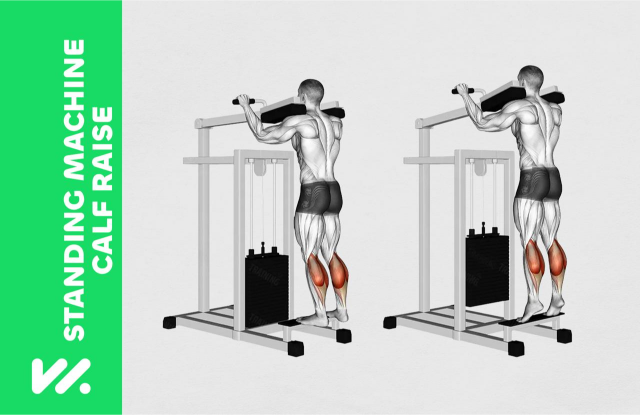
- Setup:
- Adjust the shoulder pads of the calf raise machine to fit your height.
- Step onto the platform with the balls of your feet firmly planted, heels hanging off the edge.
- Position shoulders under the pads and stand upright, gripping the handles for stability.
- Lifting Phase:
- Press through your toes to raise your heels as high as possible, flexing your calves.
- Hold the top position for 1–2 seconds to maximize muscle contraction.
- Lowering Phase:
- Slowly lower your heels below the platform level, stretching the calves fully.
- Repetitions:
- Aim for 3–4 sets of 12–20 reps (higher reps recommended due to calf endurance).
Professional Tips
Maximize Results:
- Full Range of Motion: Stretch your heels deeply at the bottom and squeeze hard at the top.
- Tempo Control: Use a 2-second lift, 1-second hold, and 3-second lowering phase.
- Foot Positioning:
- Toes Forward: Targets overall gastrocnemius.
- Toes Out: Emphasizes the inner calf.
- Toes In: Focuses on the outer calf.
Avoid Common Mistakes:
- Bouncing at the Bottom: Momentum reduces muscle tension and increases injury risk.
- Partial Reps: Failing to stretch or contract fully limits growth.
- Locking Knees: Keep a slight bend in the knees to protect joints.
Progression:
- Add weight incrementally (5–10 lbs / 2–4 kg) as your calves adapt.
- For advanced lifters, try single-leg raises to correct muscle imbalances.
Benefits of the Standing Machine Calf Raise
- Athletic Power: Boosts vertical jump and sprinting speed.
- Injury Prevention: Strengthens ankles and Achilles tendons.
- Aesthetic Appeal: Creates balanced, diamond-shaped calves.
Variations & Alternatives
- Seated Calf Raise: Targets the soleus with bent knees.
- Donkey Calf Raise: Mimics the classic bodybuilding movement for deep calf engagement.
- Bodyweight Calf Raises: No equipment needed—use stairs or a raised platform.
Pair this exercise with Leg Day Workouts or explore Advanced Calf Training Techniques for complete lower-body development