Exercise Profile
Target Muscle Group:
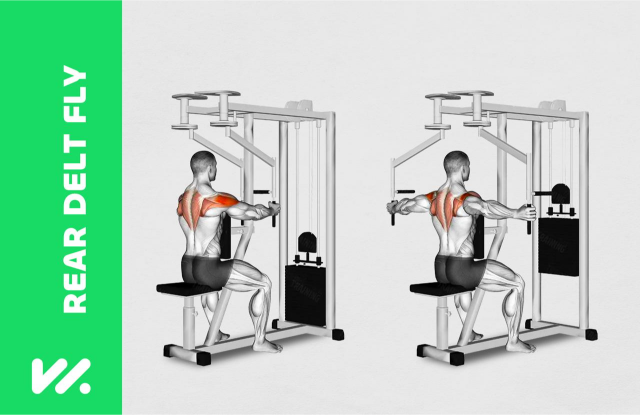
Primary: Posterior Deltoid (Rear Delts)
Secondary: Rhomboids, Trapezius, Infraspinatus, Teres Minor
Exercise Type:
Strength Training / Isolation
Single-Joint Exercise
Equipment Required:
Dumbbells, Cable Machine, or Pec Deck (Reverse Fly Machine)
Mechanics:
Isolation (Single-Joint Exercise)
Force Type:
Pull (Concentric & Eccentric Phases)
Experience Level:
Beginner to Advanced
Best For:
Shoulder sculpting, rear delt development, upper back balance, postural correction, rotator cuff support
Common Risks:
Using excessive weight, poor posture, swinging motion, over-involving traps or lower back
Overview
The Rear Delt Fly is a highly effective shoulder isolation exercise that targets the posterior deltoid—a key muscle responsible for shoulder stability, posture, and upper back strength. It’s often undertrained compared to the front and side delts, leading to muscular imbalances and forward shoulder posture. Incorporating the rear delt fly into your routine helps develop a more balanced and sculpted upper body, improves rotator cuff health, and enhances performance in pressing and pulling movements.
Exercise Instructions
Step-by-Step Form (Dumbbell Version – Seated or Bent-Over):
Setup:
Grab a pair of light to moderate dumbbells.
Sit on the edge of a bench or hinge at the hips until your torso is almost parallel to the ground.
Let the dumbbells hang directly under your shoulders with palms facing each other.
Starting Position:
Keep a neutral spine, core engaged, and a slight bend in the elbows.
Avoid rounding your back or overextending your neck.
Contraction Phase:
Exhale and raise both dumbbells out to your sides in a wide arc.
Focus on squeezing your rear delts and shoulder blades together at the top.
Peak Contraction:
Pause for 1–2 seconds at the top of the movement.
Keep tension in your upper back and avoid shrugging.
Returning Phase:
Inhale and slowly lower the dumbbells back to the starting position under control.
Do not allow the weights to swing or drop.
Repetitions:
Perform 3–4 sets of 12–20 reps.
Use light to moderate weight to prioritize form and activation.
Professional Tips
Maximize Results:
- Lead with your elbows, not your hands, to better engage the rear delts.
- Maintain a fixed torso—movement should come from the shoulders, not the back.
- Squeeze at the top to fully contract the posterior deltoids and upper back muscles.
Avoid Common Mistakes:
- Don’t go too heavy—focus on form and muscle activation.
- Avoid swinging or using momentum.
- Don’t turn it into a row—keep the movement arcing out to the sides.
Progression:
- Use cables for constant tension throughout the range of motion.
- Try the reverse pec deck machine for guided movement and stability.
- Add pause reps or supersets with face pulls for rear delt burnout.
Benefits of Rear Delt Fly
- Isolates the Rear Delts: Helps bring out definition in the back of the shoulders.
- Improves Shoulder Health: Strengthens the rotator cuff and stabilizing muscles.
- Corrects Postural Imbalances: Counters overdeveloped front delts and reduces forward-leaning posture.
- Enhances Upper Back Definition: Adds shape and thickness to the upper back.
- Supports Better Lifting Mechanics: Essential for safe and effective pressing and pulling movements.
Variations & Alternatives
- Cable Rear Delt Fly: Provides constant resistance across the movement.
- Reverse Pec Deck Fly: Machine-based version for added control.
- Resistance Band Rear Fly: Great for warm-ups and home workouts.
- Face Pulls: Dynamic movement that targets rear delts and rotator cuff muscles.
- Bent-Over Lateral Raises: A classic dumbbell variation that hits the posterior shoulders and upper back.
Incorporate the Rear Delt Fly
Add rear delt flyes to your shoulder day, pull workout, or posture-focused training to develop balanced, strong, and functional shoulders. Best performed with light to moderate weight, this movement is ideal for the end of a workout or as part of a rear delt supersets or upper-back isolation circuit. Combine with rows, pull-aparts, and Y-raises for full posterior chain development.
“The rear delt fly is a must-do for strong, healthy shoulders. It balances your physique, supports your posture, and gives your upper body that 3D look.”
— Certified Strength & Conditioning Specialist (CSCS)