Exercise Profile
Target Muscle Group:
Primary: Deep Cervical Flexors (Longus Capitis, Longus Colli)
Secondary: Suboccipital Muscles, Upper Trapezius (Stabilizers), Sternocleidomastoid
Exercise Type:
Mobility / Postural Correction
Isolation (Single-Joint Movement)
Equipment Required:
None (Bodyweight); Optional: Wall, Resistance Band, or Foam Pad
Mechanics:
Isolation (Single-Joint Exercise)
Force Type:
Pull (Isometric and Concentric Retraction)
Experience Level:
Beginner to Advanced
Best For:
Neck posture correction, cervical spine alignment, tech neck relief, desk workers, rehabilitation, prehab
Common Risks:
Overretraction, excessive chin tucking, jerky movement causing strain
Overview
The Neck Retraction exercise, also known as the chin tuck, is a simple but powerful movement that targets the deep cervical flexors, which are crucial for proper head and neck alignment. This is a must-do for anyone suffering from forward head posture, neck pain, or poor desk ergonomics. Practicing regular neck retractions can reduce strain on the upper spine, improve posture, and help restore healthy, functional movement of the cervical spine.
Exercise Instructions
Step-by-Step Form (Wall or Seated Version):
Setup:
Sit or stand upright with your spine in a neutral position.
If using a wall, stand with your back and head lightly touching it.
Starting Position:
Look straight ahead with your chin level to the ground.
Keep your shoulders relaxed and arms down by your side or on your lap.
Contraction Phase:
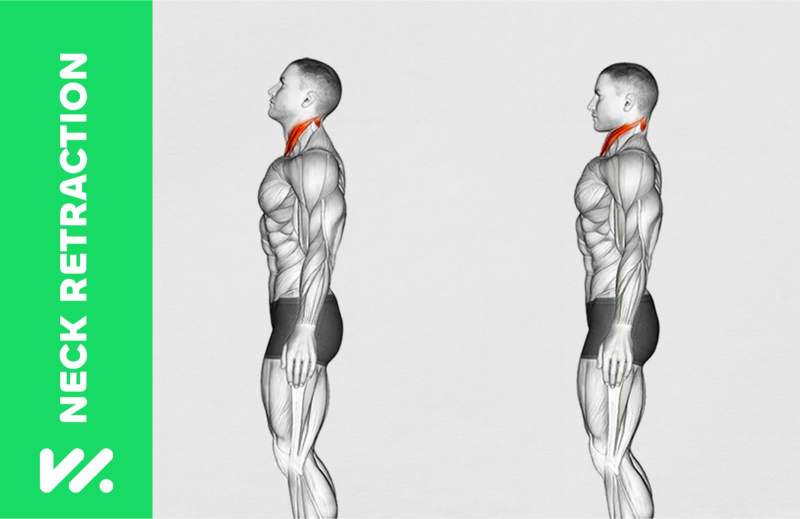
Slowly draw your head straight backward without tilting it up or down—like sliding it on a shelf.
Tuck your chin gently toward your neck while maintaining level eye gaze.
You should feel a stretch at the base of the skull and activation deep in the front of the neck.
Peak Contraction:
Hold this retracted position for 3–5 seconds.
Keep breathing and maintain tension in the cervical spine stabilizers.
Returning Phase:
Release the movement slowly and return your head to the starting neutral position.
Avoid overshooting forward.
Repetitions:
Perform 2–3 sets of 10–15 reps, daily or multiple times a day, especially for desk-bound individuals.
Professional Tips
Maximize Results:
- Think of pulling your face directly backward—not downward or upward.
- Practice in front of a mirror to avoid head tilt.
- Incorporate into your daily mobility or posture routine.
Avoid Common Mistakes:
- Don’t over-tuck the chin—this can strain your upper cervical spine.
- Avoid arching your lower back or pushing with your shoulders.
- Don’t jerk the movement—keep it slow and controlled.
Progression:
- Perform neck retractions against a wall or while lying down for better feedback.
- Add resistance using a light band or manual isometric pressure.
- Pair with scapular retraction and thoracic mobility drills for full postural correction.
Benefits of Neck Retractions
- Improves Neck Posture: Corrects forward head posture and reduces “tech neck.”
- Strengthens Deep Cervical Flexors: Activates small stabilizing muscles often weakened by poor posture.
- Relieves Neck & Shoulder Tension: Reduces stress on the upper traps, shoulders, and base of the skull.
- Enhances Spine Alignment: Promotes a neutral cervical spine position for overall spinal health.
- Supports Better Breathing & Movement: Frees up airway function and supports efficient upper-body mechanics.
Variations & Alternatives
- Wall-Assisted Neck Retraction: Provides proprioceptive feedback for beginners.
- Supine Chin Tuck: Performed lying flat with a towel behind the head.
- Band-Resisted Neck Retraction: Adds progressive resistance to the movement.
- Cervical Isometric Holds: Builds neck strength and endurance.
- Seated Ergonomic Breaks: Combine with shoulder rolls and thoracic extensions.
Incorporate the Neck Retraction
Add neck retractions to your daily mobility routine, especially if you sit at a desk, work on screens, or experience frequent neck discomfort. Ideal for morning stretches, mid-day resets, and warm-up or cooldown during workouts. Combine with thoracic spine mobility, breathing drills, and scapular strengthening to correct posture holistically.
“The neck retraction is the foundation of posture correction. Whether you’re dealing with neck pain, tech neck, or just looking to realign your spine, this simple movement should be a daily essential.”
— Rehab Specialist & Postural Alignment Coach