Exercise Profile
Target Muscle Group:
Primary: Obliques (Core)
Secondary: Rectus Abdominis, Transverse Abdominis, Glutes, Shoulders, Upper Back
Exercise Type:
Strength Training / Functional Training
Compound (Multi-Joint Exercise)
Equipment Required:
Cable Machine (with adjustable pulley)
Cable Handle or Rope Attachment
Mechanics:
Compound (Multi-Joint)
Force Type:
Pull & Rotation (Concentric & Eccentric Phases)
Experience Level:
Intermediate to Advanced (Beginners should master basic core stability first)
Best For:
Core Strength, Rotational Power, Athletic Performance, Anti-Rotation Stability
Common Risks:
Lower Back Strain (if twisting through the spine), Poor Core Engagement, Using Excessive Weight
Overview
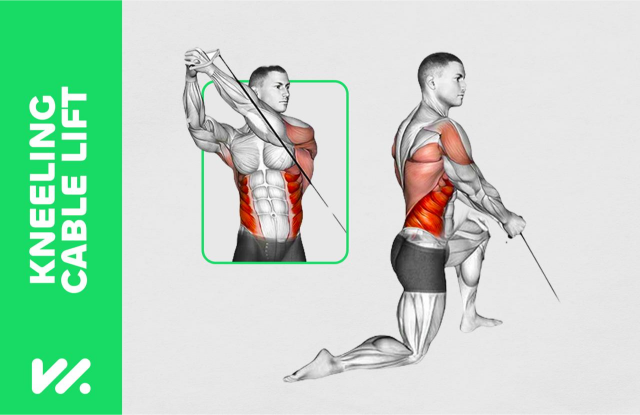
The Kneeling Cable Lift is a dynamic, functional exercise that targets the core—especially the obliques—while also engaging the shoulders, glutes, and upper back. By lifting a cable from a low to a high position across the body, you train the muscles responsible for rotational strength and anti-rotational stability. This movement is highly valued in athletic training for its carryover to sports and daily activities that require twisting, lifting, or stabilizing the trunk.
Exercise Instructions
Step-by-Step Form:
Setup:
- Attach a single handle or rope to a low pulley on a cable machine.
- Kneel sideways to the machine, with knees hip-width apart and the cable on your right (if starting on the right side).
- Grasp the handle with both hands, arms extended toward the pulley, and keep your torso upright.
Lifting Phase:
- Brace your core and glutes.
- In one smooth motion, pull the handle diagonally across your body and upward until your hands are above the opposite shoulder (from low right to high left, for example).
- Keep your arms mostly straight, moving through your shoulders and upper back, not your lower back.
Peak Contraction:
- Pause at the top, focusing on core and shoulder engagement.
- Do not allow your hips to rotate or your lower back to arch.
Lowering Phase:
- Slowly reverse the motion, returning the handle to the starting position with control.
Repetitions:
- Perform 2–4 sets of 8–12 reps per side, switching sides after each set.
Professional Tips
Maximize Results:
- Focus on keeping your hips and torso stable; all movement should come from your shoulders and upper back, not your spine.
- Squeeze your glutes and brace your abs throughout the lift for maximum core activation.
- Use a slow, controlled tempo—avoid using momentum.
Avoid Common Mistakes:
- Do not twist or arch your lower back; keep your spine neutral.
- Avoid letting your hips rotate—this reduces core engagement and increases injury risk.
- Don’t use excessive weight; prioritize form and full range of motion.
Progression:
- Increase the weight gradually as your core strength improves.
- Try standing cable lifts or half-kneeling variations for added challenge and variety.
Benefits of the Kneeling Cable Lift
- Core Strength & Stability: Trains the obliques, transverse abdominis, and deep core muscles for rotational and anti-rotational strength.
- Functional Movement: Mimics real-life actions like lifting, throwing, or swinging, making it valuable for athletes and everyday function.
- Shoulder & Upper Back Activation: Engages stabilizers and improves shoulder health.
- Injury Prevention: Builds resilience against rotational and lower back injuries.
- Improved Posture: Encourages upright, stable trunk positioning.
Variations & Alternatives
- Standing Cable Lift: Increases balance and full-body engagement.
- Half-Kneeling Cable Lift: Adds a unilateral challenge for hip stability.
- Pallof Press: Focuses on anti-rotation with a static hold.
- Medicine Ball Rotational Throw: For explosive power development.
Incorporate the Kneeling Cable Lift
Add this exercise to your core, functional, or athletic training routines. It pairs well with anti-rotation and traditional core exercises for a complete midsection workout.
“The kneeling cable lift is an exceptional core exercise that builds rotational strength and stability, which are essential for athletes and anyone looking to move better and protect their spine.”
— National Academy of Sports Medicine (NASM)