Exercise Profile
Target Muscle Group:
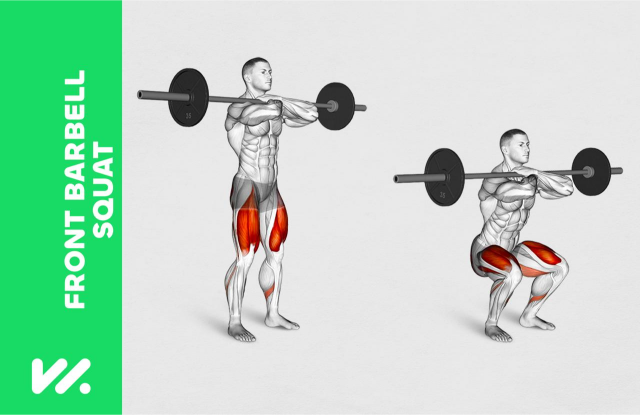
Primary: Quadriceps (Vastus Lateralis, Medialis, Intermedius, and Rectus Femoris)
Secondary: Glutes, Hamstrings, Core (Stabilizers), Upper Back, Erector Spinae
Exercise Type:
Strength Training / Compound Lift
Multi-Joint Exercise
Equipment Required:
Olympic Barbell, Squat Rack
Mechanics:
Compound (Multi-Joint Exercise)
Force Type:
Push (Concentric & Eccentric Phases)
Experience Level:
Intermediate to Advanced
Best For:
Quad development, core strength, upright squat form, functional strength, Olympic lifting foundations
Common Risks:
Wrist strain from improper grip, leaning forward, rounding the back, knee collapse (valgus)
Overview
The Front Barbell Squat, often referred to simply as the front squat, is a powerful lower-body compound movement that emphasizes the quadriceps and core. Unlike the back squat, where the load is placed across your traps, the front squat positions the barbell across your front shoulders, forcing you to maintain a more upright torso and placing greater demand on your core muscles for stabilization. This variation is commonly used by Olympic weightlifters, athletes, and functional trainers to improve squat mechanics, posture, and quad strength.
Exercise Instructions
Step-by-Step Form:
Setup:
Set a barbell in a squat rack at about chest height.
Step under the bar and rest it on the front of your shoulders (anterior deltoids), crossing your arms or using a clean grip.
Lift the bar out of the rack by standing tall, stepping back, and setting your feet shoulder-width apart.
Starting Position:
Keep elbows high, chest up, and spine neutral.
Brace your core and position your feet slightly turned out.
Descent Phase:
Inhale and lower yourself into a squat by bending at the hips and knees.
Keep your torso upright and your knees tracking over your toes.
Descend until your thighs are at least parallel to the ground (or deeper if mobility allows).
Contraction Phase:
Exhale and drive through your midfoot and heels to stand back up.
Keep your elbows lifted and core tight throughout the ascent.
Repetitions:
Perform 3–5 sets of 5–10 reps, depending on your goals.
Use moderate to heavy weight with perfect form before increasing load.
Professional Tips
Maximize Results:
- Maintain a “proud chest” and keep elbows high to prevent the bar from rolling forward.
- Drive your knees outward during the squat to engage the glutes and maintain alignment.
- Focus on core engagement—this lift is as much a core workout as it is a leg builder.
Avoid Common Mistakes:
- Don’t allow your elbows to drop—this can cause the bar to fall forward.
- Avoid rounding your back or collapsing at the bottom.
- Don’t push your hips back too far—this is not a hip-dominant squat.
Progression:
- Begin with an empty barbell to master technique.
- Use goblet squats as a progression before moving to the barbell front squat.
- Add pause reps or tempo training for increased time under tension.
Benefits of Front Squats
- Quad Emphasis: Shifts the loading forward, increasing quadriceps activation compared to the back squat.
- Improved Core Strength: Requires intense core stabilization, making it a full-body lift.
- Better Posture & Mobility: Encourages upright posture and improves thoracic extension and ankle mobility.
- Functional Strength Development: Useful for Olympic lifts, athletic movements, and day-to-day mobility.
- Joint-Friendly Mechanics: Less compressive force on the lower back due to a more vertical torso.
Variations & Alternatives
- Goblet Squat: Dumbbell or kettlebell front-loaded variation ideal for beginners.
- Zercher Squat: Barbell held in the elbow creases for increased core and arm engagement.
- Back Squat: Places more emphasis on hips and glutes.
- Safety Bar Front Squat: Uses a specialty bar for more comfort and control.
- Split Squat or Bulgarian Split Squat: Single-leg alternatives that develop balance and unilateral strength.
Incorporate the Front Barbell Squat
Add front barbell squats to your leg day, functional training, or Olympic lifting program to improve quad strength, squat mechanics, and core activation. Best performed early in the workout when energy is high, front squats pair well with lunges, RDLs, and leg presses to round out your lower body development.
“The front squat is the gold standard for building powerful quads and bulletproof core strength. If you want to lift heavier, run faster, and move better, it deserves a place in your training.”
— Strength & Conditioning Coach (CSCS)