Exercise Profile
Target Muscle Group:
Primary: Gluteus Maximus, Hamstrings
Secondary: Core (Stabilizers), Erector Spinae, Gluteus Medius
Exercise Type:
Strength Training / Eccentric Control
Compound or Isolation (Depending on Execution)
Equipment Required:
Bodyweight, Bench or Step (optional), Resistance Bands (optional), Stability Ball (optional)
Mechanics:
Controlled Eccentric Focus (Slow-Lengthening Phase)
Force Type:
Push + Eccentric (Slow Muscle Lengthening Under Load)
Experience Level:
Intermediate to Advanced
Best For:
Glute and hamstring strength, injury prevention, posterior chain development, eccentric training, hip extension mechanics
Common Risks:
Lower back strain if performed with poor form or compensation, improper core engagement, excessive speed during the lowering phase
Overview
The Eccentric Hip Extension is a powerful variation of traditional hip extension exercises, emphasizing the eccentric (lengthening) phase to build strength, control, and muscle resilience. By slowing down the lowering portion of the movement, you create greater muscle tension, which enhances glute and hamstring development, supports hip function, and reduces the risk of injury. This technique is essential for athletes, rehabilitation programs, and anyone looking to master posterior chain strength and hip mobility.
Exercise Instructions
Step-by-Step Form (Bodyweight Version):
Setup:
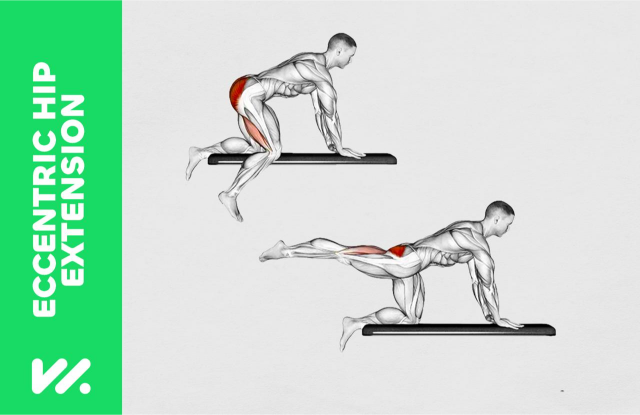
Lie face down on a mat or bench, knees bent at 90 degrees, or use a stability ball for added difficulty.
Alternatively, perform on hands and knees for a quadruped variation.
Starting Position:
Contract your core and keep your spine neutral.
Lift one leg to extend the hip without arching your lower back.
Contraction Phase:
Exhale and raise your leg by engaging your glutes and extending your hip.
Lift slowly and pause briefly at the top.
Eccentric (Lowering) Phase:
Inhale and lower the leg very slowly, maintaining tension in your glutes and hamstrings.
Focus on controlling the descent over 3–5 seconds for maximum benefit.
Repetitions:
Perform 3–4 sets of 6–10 reps per leg.
Rest 30–60 seconds between sets.
Professional Tips
Maximize Results:
- Use a 3 to 5-second eccentric phase for optimal muscle stimulation.
- Keep your core engaged and avoid hyperextending your spine.
- Focus on using the glute muscles, not momentum or your lower back.
Avoid Common Mistakes:
- Don’t drop the leg quickly—eccentric control is the goal.
- Avoid arching the back or letting the hips rotate.
- Don’t let the opposite leg or arms compensate—stay stable.
Progression:
- Add a resistance band around the thighs for increased challenge.
- Try the single-leg stability ball eccentric hip extension.
- Increase time under tension by using tempo training (e.g., 3-0-1-0).
Benefits of Eccentric Hip Extension
- Eccentric Glute & Hamstring Strength: Focuses on the lengthening phase to improve strength, control, and hypertrophy.
- Injury Prevention: Builds tissue resilience, reducing risk of hamstring strains, glute weakness, and lower back pain.
- Posterior Chain Development: Complements compound lifts like deadlifts, squats, and lunges.
- Improves Hip Mobility & Control: Enhances range of motion and functional hip extension patterns.
- Perfect for Rehab & Prehab: Ideal for those recovering from injury or seeking to prevent muscular imbalances.
Variations & Alternatives
- Stability Ball Eccentric Hip Extension: Adds instability to challenge balance and coordination.
- Resistance Band Eccentric Kickbacks: Targets glutes with added resistance and control.
- Romanian Deadlift (Eccentric Focus): Weighted alternative for building eccentric strength in the entire posterior chain.
- Eccentric Glute Bridge: Slow hip lift lowering phase while keeping the spine neutral.
- Single-Leg Hip Extension Hold + Eccentric Lowering: Increases difficulty and isolation.
Incorporate the Eccentric Hip Extension
Use eccentric hip extensions as part of your glute training, rehab routine, or posterior chain workout to build stronger, more injury-resistant muscles. Perform before heavier compound lifts to prime the glutes or after workouts as a finisher for glute burn and time under tension. Pair with glute bridges, deadlifts, or reverse lunges for a complete lower-body routine.
“The eccentric hip extension is an underrated movement that builds not only strength, but also control and injury resistance. It’s a must for serious athletes and smart lifters.”
— Certified Performance Coach (CSCS)