Exercise Profile
Target Muscle Group:
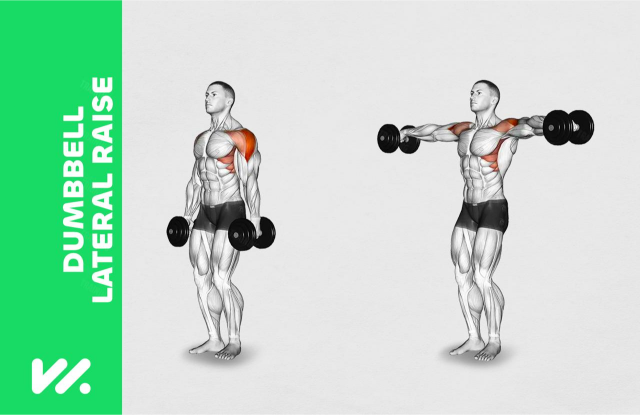
Primary: Lateral Deltoid (Middle Shoulder)
Secondary: Anterior Deltoid (Front Shoulder), Upper Trapezius, Supraspinatus, Serratus Anterior, Stabilizers in Arms and Core
Exercise Type:
Strength Training / Hypertrophy
Isolation Exercise
Equipment Required:
Dumbbells
Mechanics:
Isolation (Single-Joint Exercise)
Force Type:
Lift (Concentric & Eccentric Phases)
Experience Level:
Beginner to Advanced
Best For:
Shoulder Width and Definition, Shoulder Stability, Upper Body Aesthetics
Common Risks:
Shoulder Impingement (if raised above shoulder height or using excessive weight), Poor Form Leading to Swinging or Momentum
Overview
The Dumbbell Lateral Raise is a staple isolation exercise for developing the lateral deltoids—the muscles responsible for the width and rounded appearance of your shoulders. By lifting dumbbells out to your sides, you directly target the “cap” of the shoulder, helping to create a broader, more athletic silhouette. This exercise is simple to perform, requires only a pair of dumbbells, and is effective for all experience levels when executed with proper form
Exercise Instructions
Step-by-Step Form:
Setup:
- Stand tall with feet shoulder-width apart.
- Hold a dumbbell in each hand at your sides, palms facing your body.
- Engage your core and maintain a neutral spine
Raising Phase:
- With a slight bend in your elbows, exhale and slowly lift the dumbbells out to the sides.
- Lead with your elbows (not your hands), raising your arms until they are parallel to the ground—no higher than shoulder height
- Keep your shoulder blades back and down, away from your ears.
Peak Contraction:
- Pause briefly at the top, squeezing your shoulder muscles to maximize contraction5.
Lowering Phase:
- Inhale and lower the weights with control back to the starting position.
- Avoid letting the weights drop quickly; maintain tension throughout
Repetitions:
- Perform 2–4 sets of 8–15 reps, depending on your goals.
- Use lighter weights for strict form and higher reps for muscle growth
Professional Tips
Maximize Results:
- Focus on a slow, controlled movement for maximum deltoid engagement.
- Use a slight bend in your elbows and avoid locking your arms
- Lead with your elbows to target the lateral deltoid rather than the traps or front delts.
- Keep your wrists neutral and avoid rotating your hands upward.
Avoid Common Mistakes:
- Do not swing the weights or use momentum—this reduces effectiveness and increases injury risk
- Avoid raising the dumbbells above shoulder height to protect your shoulder joints.
- Do not shrug your shoulders or tense your neck during the lift.
- Select a weight you can control; going too heavy often leads to poor form3.
Progression:
- Gradually increase weight in small increments (1–2 kg) as strength improves, always prioritizing form.
- Try advanced variations like single-arm, cable, or machine lateral raises for variety and new stimulus
Benefits of the Dumbbell Lateral Raise
- Shoulder Width and Shape: Emphasizes the lateral deltoid, creating a broader, more defined shoulder profile
- Improved Shoulder Mobility & Stability: Strengthens muscles that stabilize the shoulder joint, reducing injury risk and improving functional movement
- Enhanced Athletic Performance: Supports upper body strength for sports and daily activities requiring overhead or lateral arm movement
- Rehabilitation: Useful for rebuilding strength and mobility after shoulder injuries (when performed with correct form and appropriate load)
Variations & Alternatives
- Alternating Lateral Raise: Lift one arm at a time for increased core engagement and focus
- Thumbs-Up Grip: Palms facing forward to shift emphasis slightly to the front deltoid
- Cable Lateral Raise: Provides constant tension throughout the movement.
- Seated Lateral Raise: Reduces cheating by limiting body swing.
- Machine Lateral Raise: Offers guided motion for beginners or those seeking joint stability.
Incorporate Dumbbell Lateral Raises
Add this exercise to your shoulder or upper body routine to maximize shoulder development and aesthetics. Pair with compound movements like the overhead press for complete shoulder training
“Lateral raises help increase shoulder mobility, range of motion, stability, and strength… Doing this exercise can help you achieve defined shoulders and upper arms that have a rounded appearance.”
— John Gallucci Jr., Physical Therapist