Exercise Profile
Target Muscle Group:
Primary: Gastrocnemius (medial and lateral heads), Soleus
Secondary: Tibialis Posterior, Ankle Stabilizers
Exercise Type:
Strength Training / Hypertrophy
Isolation (Single-Joint Exercise)
Equipment Required:
Leg Press Machine (Horizontal, 45°, or Seated Leg Press)
Mechanics:
Isolation (Single-Joint Exercise)
Force Type:
Push (Concentric & Eccentric Phases)
Experience Level:
Beginner to Advanced
Best For:
Calf development, ankle strength, lower leg size and definition, athletic performance, leg symmetry
Common Risks:
Overloading the weight, limited range of motion, bouncing reps, Achilles strain
Overview
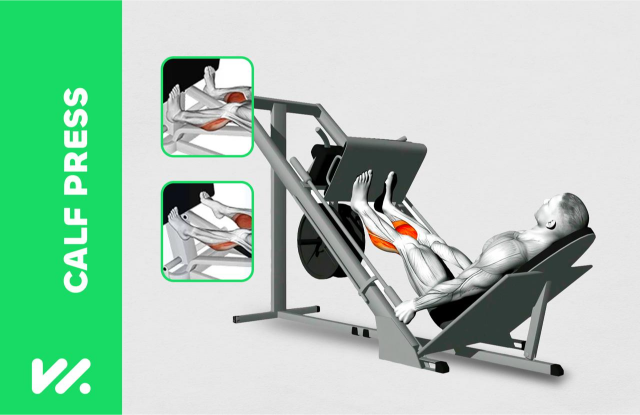
The Calf Press on a leg press machine is a powerful calf isolation exercise that targets the gastrocnemius and soleus muscles—key players in lower leg strength, balance, and power. This machine-based movement allows for heavy loading with minimal risk of imbalance or poor posture, making it ideal for both beginners and experienced lifters. Whether you’re looking to improve your vertical jump, enhance aesthetic leg development, or strengthen your ankles and calves, the calf press is a must-have in your leg workout routine.
Exercise Instructions
Step-by-Step Form:
Setup:
Sit on a leg press machine and place the balls of your feet on the lower portion of the platform.
Your heels should hang slightly off the edge to allow for full range of motion.
Keep your legs nearly straight but avoid locking your knees.
Starting Position:
Press the sled away using your feet and disengage the safety stops.
Keep tension in your calves and prepare for controlled movement.
Contraction Phase:
Exhale and press the balls of your feet against the platform, extending your ankles by raising your heels as high as possible.
Focus on contracting the calf muscles—especially the gastrocnemius—at the top.
Peak Contraction:
Pause at the top of the motion and squeeze your calves tightly.
Do not let your knees bend or shift the load.
Returning Phase:
Inhale and slowly lower your heels until you feel a deep calf stretch.
Avoid bouncing at the bottom—control the entire motion.
Repetitions:
Perform 3–5 sets of 12–20 reps, depending on your goal.
Use higher reps for hypertrophy and endurance, and moderate weight to avoid joint strain.
Professional Tips
Maximize Results:
- Focus on full range of motion—drop your heels low and lift them high.
- Keep your knees slightly bent, not locked.
- Slow down the eccentric phase (lowering) to increase time under tension.
Avoid Common Mistakes:
- Don’t bounce at the bottom—it can strain your Achilles tendon.
- Avoid pushing with your toes—drive through the balls of your feet.
- Don’t load too much weight and compromise form.
Progression:
- Try using one leg at a time to isolate and correct imbalances.
- Add pause reps or slow tempo sets to shock the muscles.
- Combine with seated calf raises to target both heads of the calf complex.
Benefits of the Calf Press
- Isolated Calf Development: Focuses entirely on calf muscles without taxing the upper body.
- Improves Ankle Stability & Mobility: Strengthens the supporting structures around the ankle joint.
- Enhances Athletic Performance: Crucial for running, sprinting, jumping, and change-of-direction movements.
- Supports Functional Movement: Helps with walking, climbing stairs, and lower-body coordination.
- Machine-Controlled Safety: Allows for heavy lifting with reduced injury risk and better balance.
Variations & Alternatives
- Seated Calf Raise: Emphasizes the soleus muscle more with bent knees.
- Standing Calf Raise: Uses bodyweight or machine to target calves in a natural standing position.
- Donkey Calf Raise: Provides an intense stretch and load in a bent-over position.
- Single-Leg Calf Press: Focuses on one calf at a time to correct muscular imbalances.
- Tibialis Raises: Strengthens the front of the lower leg for ankle balance and injury prevention.
Incorporate the Calf Press
Add the calf press to your leg day, lower body, or athletic performance training routines to balance your leg development and strengthen your calf muscles. It works great when paired with compound movements like squats and lunges to ensure you’re not neglecting the lower legs. Train calves 2–3 times per week to build volume and definition.
“If you’re skipping calves, you’re skipping half your legs. The calf press is the safest and most effective way to add size, strength, and performance to your lower legs.”
— Certified Personal Trainer (CPT)