Exercise Profile
Target Muscle Group:
Primary: Forearm Flexors (Flexor Carpi Radialis, Flexor Carpi Ulnaris, Palmaris Longus)
Secondary: Grip Muscles, Brachioradialis
Exercise Type:
Strength Training / Hypertrophy
Isolation (Single-Joint Exercise)
Equipment Required:
Barbell
Mechanics:
Isolation (Single-Joint)
Force Type:
Pull (Concentric & Eccentric Phases)
Experience Level:
Beginner to Advanced
Best For:
Forearm Size and Strength, Grip Endurance, Wrist Stability
Common Risks:
Wrist Strain (from excessive weight or poor form), Bar Slippage, Overextension
Overview
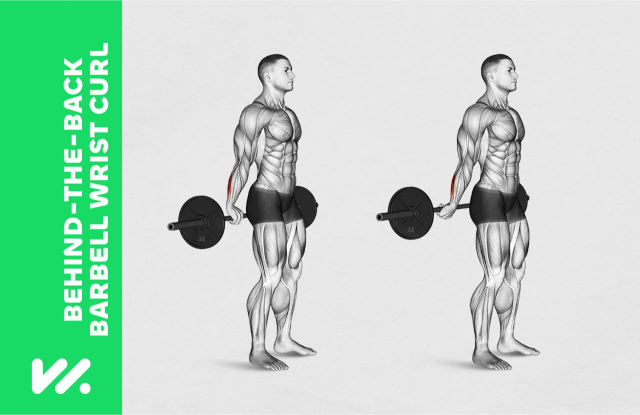
The Behind-The-Back Barbell Wrist Curl is a classic isolation exercise designed to build the forearm flexors and improve grip strength. By positioning the barbell behind your body, you place the forearms in an optimal position for maximal contraction and stretch. This exercise is especially popular among bodybuilders, climbers, and athletes who require strong, muscular forearms for performance and aesthetics.
Exercise Instructions
Step-by-Step Form:
Setup:
- Stand upright with feet shoulder-width apart.
- Hold a barbell behind your back with both hands, palms facing backward (away from your body), and arms fully extended.
- Hands should be about shoulder-width apart, and the bar should rest against your glutes or upper hamstrings.
Starting Position:
- Allow the bar to roll down to your fingertips, keeping your wrists extended and arms straight.
Curling Phase:
- Exhale and curl the bar upward by flexing your wrists, bringing your palms toward your forearms.
- Keep your elbows locked and stationary throughout the movement.
Peak Contraction:
- Squeeze your forearms at the top, holding for 1–2 seconds.
Lowering Phase:
- Inhale and slowly lower the bar back to the starting position, allowing it to roll down to your fingertips for a full stretch.
Repetitions:
- Perform 3–4 sets of 12–20 reps, using a weight that allows you to maintain strict form.
Professional Tips
Maximize Results:
- Focus on a slow, controlled movement—avoid using momentum.
- Let the bar roll to your fingertips on each rep for a greater range of motion and better forearm stretch.
- Squeeze tightly at the top to maximize muscle activation.
Avoid Common Mistakes:
- Don’t use excessive weight, which can strain your wrists or cause the bar to slip.
- Avoid bending your elbows—keep arms straight to isolate the forearms.
- Don’t rush the movement; control both the upward and downward phases.
Progression:
- Gradually increase the weight as your forearm strength improves.
- Try adding a pause at the top for increased time under tension.
Benefits of the Behind-The-Back Barbell Wrist Curl
- Forearm Hypertrophy: Directly targets the flexor muscles for size and definition.
- Grip Strength: Improves grip endurance and power for sports, lifting, and daily tasks.
- Wrist Stability: Strengthens the muscles that support healthy wrist function and injury prevention.
- Aesthetic Development: Adds thickness and vascularity to the forearms for a balanced physique.
Variations & Alternatives
- Seated Barbell Wrist Curl: Performed with forearms resting on thighs or a bench for more support.
- Reverse Wrist Curl: Palms facing down to target the forearm extensors.
- Dumbbell Wrist Curl: Allows for unilateral training and correction of imbalances.
- Wrist Roller: Uses a rolling motion to build forearm and grip endurance.
Incorporate the Behind-The-Back Barbell Wrist Curl
Add this exercise to your arm or forearm routines to maximize grip and forearm development. Pair with reverse curls, hammer curls, and grip work for complete lower arm training.
“Behind-the-back wrist curls are a staple for anyone seeking bigger, stronger forearms. They isolate the flexors and provide a deep stretch and contraction, making them a must for forearm development.”
— Bodybuilding.com