Exercise Profile
Target Muscle Group:
Primary: Gluteus Maximus
Secondary: Hamstrings, Quadriceps, Erector Spinae (Lower Back), Core
Exercise Type:
Strength Training / Hypertrophy
Equipment Required:
Barbell
Bench or Hip Thrust Platform
Barbell Pad (recommended for comfort)
Mechanics:
Compound (Multi-Joint Exercise)
Force Type:
Push (Concentric & Eccentric Phases)
Experience Level:
Beginner to Advanced
Best For:
Glute Development, Explosive Hip Power, Lower Body Strength, Athletic Performance
Common Risks:
Lower Back Strain (if hyperextending or overarching), Hip Discomfort (if pad/bar placement is poor), Poor Range of Motion
Overview
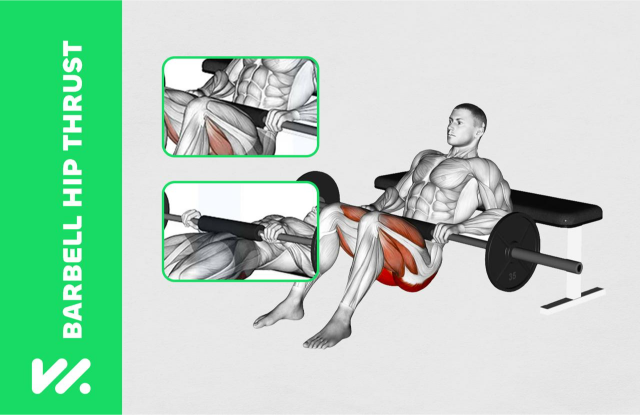
The Barbell Hip Thrust is a premier exercise for building strong, powerful glutes. By positioning your upper back on a bench and driving your hips upward against resistance, you maximize glute activation while minimizing lower back involvement. This movement is widely used by athletes for improving sprint speed and jump height, and by physique enthusiasts for developing a rounded, lifted posterior. The hip thrust is also a safe and effective way to overload the glutes with heavy weight.
Exercise Instructions
Step-by-Step Form:
Setup:
- Sit on the floor with your upper back resting against a bench or hip thrust platform.
- Roll a loaded barbell over your hips, using a barbell pad for comfort.
- Bend your knees and place your feet flat on the floor, shoulder-width apart.
Starting Position:
- Brace your core and keep your chin tucked (looking forward).
- Position the bar so it sits comfortably in the crease of your hips.
Thrusting Phase:
- Exhale and drive through your heels, lifting your hips until your thighs are parallel to the floor and your body forms a straight line from shoulders to knees.
- Squeeze your glutes hard at the top, keeping your ribs down and core tight.
Peak Contraction:
- Pause briefly at the top, focusing on maximum glute contraction.
Lowering Phase:
- Inhale and slowly lower your hips back to the starting position, maintaining control and tension in your glutes.
Repetitions:
- Perform 3–4 sets of 8–15 reps, adjusting weight and reps for your goals.
Professional Tips
Maximize Results:
- Focus on driving through your heels and keeping your knees in line with your toes.
- Tuck your chin and keep your ribs down to avoid hyperextending your lower back.
- Use a full range of motion—hips should reach full extension at the top.
Avoid Common Mistakes:
- Don’t overarch your lower back at the top—keep your core engaged.
- Avoid pushing through your toes, which reduces glute activation.
- Don’t let your knees cave inward; maintain alignment with your hips and feet.
Progression:
- Gradually increase the weight as your glute strength improves.
- Try single-leg hip thrusts or pause reps for added challenge and variety.
Benefits of the Barbell Hip Thrust
- Glute Hypertrophy: Maximally activates the gluteus maximus for muscle growth and shape.
- Explosive Power: Improves hip extension strength for sprinting, jumping, and athletic movements.
- Lower Back Friendly: Reduces spinal loading compared to traditional squats or deadlifts.
- Versatile: Suitable for all levels and easily adjustable for progressive overload.
- Improved Posture and Pelvic Stability: Strengthens the muscles that support healthy hip and pelvic alignment.
Variations & Alternatives
- Single-Leg Hip Thrust: Unilateral version to correct imbalances and increase core demand.
- Banded Hip Thrust: Adds resistance at the top for greater glute activation.
- Smith Machine Hip Thrust: Provides stability for heavier loads or beginners.
- Glute Bridge: Performed from the floor for beginners or as a burnout finisher.
Incorporate the Barbell Hip Thrust
Add this exercise to your lower body, glute-focused, or athletic training routines for optimal glute development and hip power. Pair with squats, lunges, and deadlifts for a complete lower body workout.
“The barbell hip thrust is one of the most effective exercises for maximizing glute activation and strength. It’s a staple for athletes and anyone seeking a stronger, more powerful lower body.”
— Bret Contreras, PhD (“The Glute Guy”)