Exercise Profile
Target Muscle Group:
Primary: Hamstrings (Biceps Femoris, Semitendinosus, Semimembranosus)
Secondary: Calves (Gastrocnemius), Gluteus Maximus (minor), Core (stabilizers)
Exercise Type:
Strength Training / Hypertrophy
Isolation (Single-Joint Exercise)
Equipment Required:
Leg Curl Machine (Seated, Lying, or Standing)
Mechanics:
Isolation (Single-Joint Exercise)
Force Type:
Pull (Concentric & Eccentric Phases)
Experience Level:
Beginner to Advanced
Best For:
Hamstring development, posterior chain strength, leg symmetry, knee health, athletic performance
Common Risks:
Knee joint strain, poor alignment, overextension, or bouncing during reps
Overview
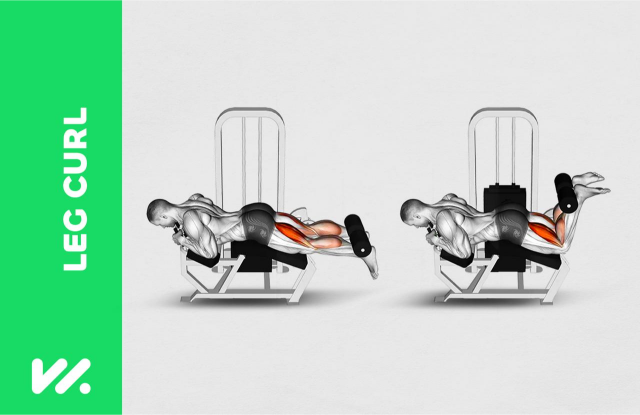
The Leg Curl is a foundational hamstring isolation exercise designed to strengthen the muscles at the back of your thighs. Whether performed seated, lying, or standing, this movement targets the hamstrings by simulating the knee flexion action they naturally perform. Ideal for beginners and athletes alike, leg curls help prevent injury, improve posterior chain balance, and enhance performance in activities such as sprinting, jumping, and lifting. Including this move in your lower-body workout ensures your hamstrings receive equal attention to the quads for functional and aesthetic symmetry.
Exercise Instructions
Step-by-Step Form:
Setup:
Adjust the leg curl machine to fit your height and leg length.
Position the roller pad just above your heels and below your calves.
Sit or lie flat depending on the machine type, and grip the handles for support.
Starting Position:
Keep your toes pointed forward or slightly downward.
Engage your core and keep your hips in contact with the pad.
Contraction Phase:
Exhale and curl your heels toward your glutes by bending at the knees.
Focus on contracting the hamstrings—do not lift your hips or use momentum.
Peak Contraction:
Pause at the top of the movement and squeeze your hamstrings for 1–2 seconds.
Avoid rushing through this phase—maximize the mind-muscle connection.
Returning Phase:
Inhale and slowly extend your legs back to the starting position.
Control the descent to maintain tension and protect the knee joint.
Repetitions:
Perform 3–4 sets of 10–15 reps.
Start with light to moderate weight and increase as strength improves.
Professional Tips
Maximize Results:
- Maintain full contact with the pad throughout the movement.
- Use a controlled tempo to enhance muscle activation and minimize joint strain.
- Point your toes slightly downward to reduce calf involvement and emphasize hamstring isolation.
Avoid Common Mistakes:
- Don’t arch your back or lift your hips off the pad.
- Avoid letting the weight slam down—control every rep.
- Don’t use excessive weight that compromises form.
Progression:
- Try single-leg leg curls to correct muscle imbalances.
- Add pause reps at the top or slow eccentric reps for greater muscle fatigue.
- Combine with Romanian deadlifts for complete hamstring development.
Benefits of the Leg Curl
- Hamstring Isolation: Effectively strengthens the muscles responsible for knee flexion and hip extension.
- Improved Athletic Performance: Enhances power for sprinting, jumping, and dynamic movement.
- Injury Prevention: Reduces the risk of hamstring strains, knee pain, and lower-back issues.
- Posterior Chain Development: Balances the strength between the quads and hamstrings for functional symmetry.
- Machine-Controlled Safety: Ideal for beginners, rehab, and controlled strength training.
Variations & Alternatives
- Lying Leg Curl: Performed face down; emphasizes full hamstring contraction.
- Seated Leg Curl: Keeps hips flexed, placing more stretch on the hamstrings.
- Standing Single-Leg Curl: Adds balance and unilateral focus.
- Glute Bridge Hamstring Curl: Performed with sliders or a stability ball for core and hamstring activation.
- Nordic Hamstring Curl: An advanced bodyweight variation for eccentric strength and injury prevention.
Incorporate the Leg Curl
Add leg curls to your lower body, posterior chain, or leg day routines to directly target and develop the hamstrings. They pair well with deadlifts, lunges, and glute bridges for a complete backside workout. Include them 1–2 times per week to improve leg aesthetics, reduce injury risk, and enhance functional performance.
“The leg curl is essential for building strong, injury-resistant hamstrings. It’s not just a bodybuilding movement—it’s a smart addition to any strength and performance program.”
— Certified Strength Coach (CSCS)