Exercise Profile
Target Muscle Group:
Primary: Erector Spinae (Lower Back)
Secondary: Gluteus Maximus, Hamstrings, Core Stabilizers
Exercise Type:
Strength Training / Rehabilitation
Isolation (Single-Joint Exercise)
Equipment Required:
Roman Chair, Hyperextension Bench, Stability Ball, or Bodyweight (Floor-Based)
Mechanics:
Isolation (Single-Joint Exercise)
Force Type:
Pull (Concentric & Eccentric Phases)
Experience Level:
Beginner to Advanced
Best For:
Lower back strength, posterior chain development, core stability, posture correction, injury prevention
Common Risks:
Lower back strain from overextension, poor alignment, or using momentum
Overview
The Back Extension is a highly effective lower back exercise that targets the erector spinae—the deep spinal muscles responsible for maintaining posture and spinal stability. Often overlooked, strengthening these muscles is crucial for preventing back pain, enhancing athletic performance, and supporting safe movement in everyday life and heavy lifting. Whether using a Roman chair, hyperextension bench, or bodyweight, back extensions improve spinal endurance and fortify the entire posterior chain.
Exercise Instructions
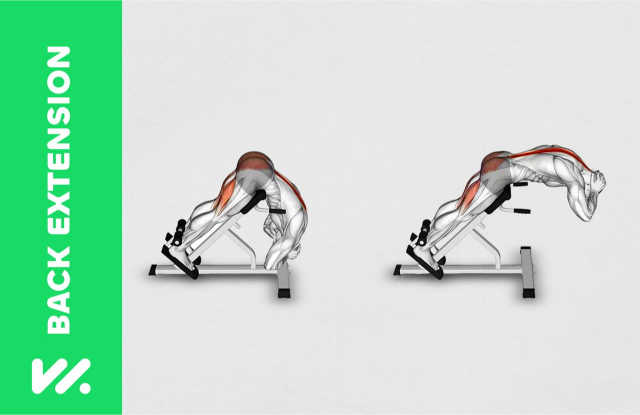
Step-by-Step Form (Hyperextension Bench):
Setup:
Adjust the pad so that your hips rest just above it.
Cross your arms over your chest or place your hands behind your head. Secure your feet under the footpads.
Starting Position:
Maintain a straight line from your head to your tailbone.
Engage your core muscles and keep your neck neutral.
Contraction Phase:
Exhale and lift your torso upward by contracting your lower back muscles.
Raise until your body forms a straight line (not arching), focusing on the glutes and hamstrings for support.
Peak Contraction:
Pause briefly at the top and squeeze your lower back and glutes.
Avoid hyperextending beyond neutral.
Returning Phase:
Inhale and slowly lower your torso back down to the starting position under control.
Maintain spinal alignment and avoid bouncing.
Repetitions:
Perform 3–4 sets of 10–15 reps.
Use bodyweight at first, then add weight plates or resistance bands for progression.
Professional Tips
Maximize Results:
- Move slowly and with control—especially on the way down.
- Engage your core and glutes to assist your lower back.
- Keep your spine neutral throughout the movement.
Avoid Common Mistakes:
- Don’t hyperextend your back at the top—it can lead to strain.
- Avoid swinging or using momentum.
- Don’t let your hips slide forward on the pad—keep them anchored.
Progression:
- Hold a weight plate across your chest for added resistance.
- Use a stability ball to challenge balance and increase core demand.
- Try single-leg back extensions to isolate each side of the lower back.
Benefits of Back Extensions
- Lower Back Strength: Reinforces the erector spinae, key to preventing back injuries.
- Improves Posture: Strengthens the muscles that hold your spine upright.
- Supports Lifting Performance: Crucial for deadlifts, squats, and other compound lifts.
- Injury Prevention: Protects against common lower back issues from poor mechanics or weak musculature.
- Functional Core Development: Builds endurance and control in your posterior core.
Variations & Alternatives
- Roman Chair Back Extension: Most popular variation for gym use.
- Bodyweight Floor Extension (Superman Hold): Beginner-friendly option for home or rehab.
- Stability Ball Back Extension: Adds balance challenge and core activation.
- Good Morning (Barbell): Dynamic compound movement for advanced posterior chain training.
- Reverse Hyperextension: Focuses more on glutes and hamstrings with lower back support.
Incorporate the Back Extension
Add back extensions to your posterior chain, core, or rehab-focused workouts to build endurance and strength in your lower back. Pair them with glute bridges, deadlifts, and plank variations to reinforce a strong and stable spine. Great as a warm-up, accessory lift, or recovery movement, this exercise is essential for structural balance and long-term health.
“The back extension is your insurance policy for a strong, injury-resistant lower back. It’s one of the smartest ways to reinforce your spine and improve your lifting longevity.”
— Certified Strength & Conditioning Specialist (CSCS)