Exercise Profile
Target Muscle Group:
- Primary: Quadriceps, Gluteus Maximus, Hamstrings
- Secondary: Erector Spinae (Lower Back), Core Stabilizers, Adductors
Exercise Type:
- Strength Training / Hypertrophy (Compound Movement)
Equipment Required:
- Barbell
- Squat Rack
- Weight Plates
Mechanics:
- Compound (Multi-Joint Exercise – Hip and Knee Dominant)
Force Type:
- Push (Concentric & Eccentric Phases)
Experience Level:
- Intermediate to Advanced (Requires foundational mobility and technique)
Best For:
- Leg Muscle Growth, Functional Strength, Athletic Performance
Common Risks:
- Lower Back Injury (if spinal alignment is compromised)
- Knee Strain (with improper knee tracking or excessive forward lean)
Overview
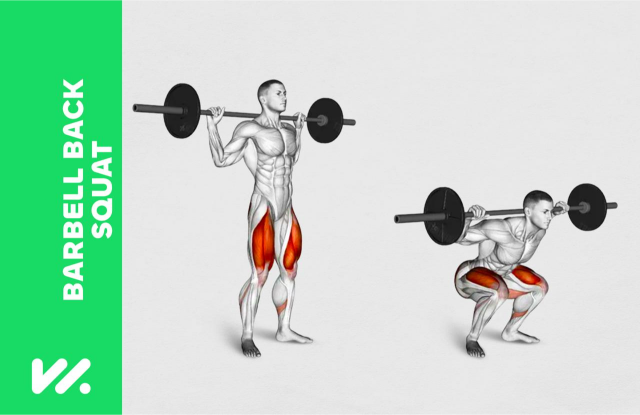
The Barbell Back Squat is the gold standard of lower-body exercises, renowned for building explosive leg strength, enhancing athletic performance, and promoting hormonal responses that drive total-body muscle growth. By loading the barbell across the upper back, you engage the entire posterior chain (glutes, hamstrings, lower back) and quads while challenging core stability. Ideal for powerlifters, athletes, and fitness enthusiasts, this exercise improves squat mechanics for daily movements, sports, and heavy lifting.
Exercise Instructions
Step-by-Step Form:
- Setup:
- Position the barbell on a squat rack at shoulder height.
- Step under the bar, resting it on your upper traps (high-bar) or rear delts (low-bar).
- Grip the bar slightly wider than shoulder-width, elbows down and back.
- Unrack the bar, step back, and stand with feet shoulder-width apart, toes slightly out.
- Descent Phase:
- Push hips back, bend knees, and lower until thighs are parallel to the floor (or lower).
- Keep chest up, knees tracking over toes, and spine neutral.
- Ascent Phase:
- Drive through your heels, extending hips and knees to return to standing.
- Squeeze glutes at the top without hyperextending your lower back.
- Repetitions:
- Perform 3–5 sets of 5–8 reps for strength or 8–12 reps for hypertrophy.
Professional Tips
Maximize Results:
- Bracing: Inhale deeply into your diaphragm, brace your core, and maintain tension throughout the lift.
- Foot Positioning:
- Wider Stance: Emphasizes glutes and adductors.
- Narrow Stance: Targets quads.
- Tempo: Lower with control (3–4 seconds), explode upward.
Avoid Common Mistakes:
- Rounding the Back: Maintain a neutral spine—never let your chest collapse forward.
- Knee Valgus: Prevent knees from caving inward; push them outward.
- Heel Lift: Keep feet flat to engage glutes and hamstrings.
Progression:
- Add 5–10 lbs (2–4 kg) weekly while prioritizing form.
- Advanced lifters can try paused squats (2–3 seconds at the bottom) or belt squats for core overload.
Benefits of the Barbell Back Squat
- Total-Body Strength: Activates 200+ muscles, including core and upper back.
- Functional Fitness: Enhances mobility for lifting, jumping, and running.
- Hormonal Response: Boosts testosterone and growth hormone production.
- Bone Density: Weight-bearing nature strengthens bones over time.
Variations & Alternatives
- Front Squat: Shifts emphasis to quads and upper back (barbell in front rack).
- Overhead Squat: Improves mobility and shoulder stability (barbell held overhead).
- Goblet Squat: Beginner-friendly alternative with a dumbbell or kettlebell.
- Box Squat: Teaches proper depth and hip hinge mechanics.
- Bulgarian Split Squat: Unilateral variation for balancing leg strength.
Incorporate this exercise into Leg Day Workouts, Powerlifting Programs, or Full-Body Routines to unlock unparalleled strength and muscle gains!